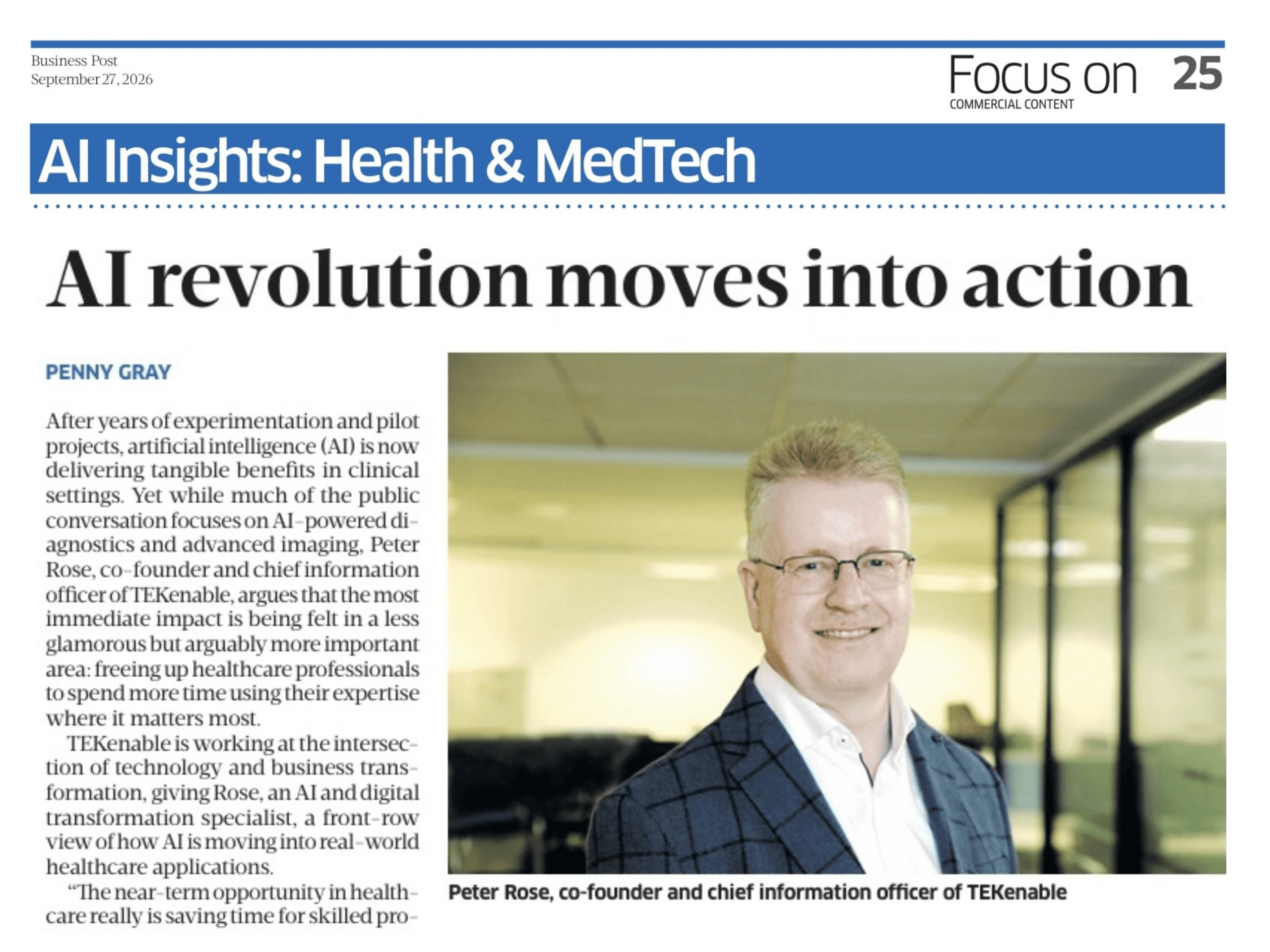
After years of experimentation and pilot projects, AI is now delivering tangible benefits in clinical settings. Yet while much of the public conversation focuses on AI-powered diagnostics and advanced imaging, Peter Rose, co-founder and chief information officer of TEKenable, argues that the most immediate impact is being felt in a less glamorous but arguably more important area: freeing up healthcare professionals to spend more time using their expertise where it matters most.
As an AI and digital transformation specialist, TEKenable is working at the intersection of technology and business transformation, giving Rose a front-row view of how AI is moving into real-world healthcare applications.
“The near-term opportunity in healthcare really is saving time for skilled professionals,” he said. “It may sound a little bit boring, as it’s not a super-exciting high-tech solution, but that’s where the impact is happening today.”
In fact, despite its unexciting nature, Rose argues it’s exactly where overstretched health systems stand to gain the most.
“We have what feels like unlimited demand for healthcare services, but a finite number of skilled clinicians,” he said. “The vast majority of their day is spent gathering information, documenting conversations and producing reports. That’s where AI can make an enormous difference.”
Beyond documentation, Rose believes AI’s greatest long-term potential lies in helping healthcare move from treating illness to preventing it.
“The healthcare system has actually become very good at collecting data,” he said. “As electronic patient records become more common, we finally have the opportunity to use that information proactively rather than reactively.”
Connected medical devices already generate continuous streams of patient data, from glucose monitors to wearable health sensors. AI can identify gradual changes that patients and clinicians might otherwise miss.
“People don’t always notice slow deterioration over time, but AI is exceptionally good at recognising trends,” Rose explained. “It can flag when someone is drifting towards illness and recommend an intervention before they end up in hospital. That’s better for the patient, and it’s much more efficient for the health service.”
Aggregated at scale, the same data can also improve service planning by revealing population-level patterns and helping health systems allocate resources more effectively. “Once you’ve got comparable data, that’s when the magic really starts to happen,” he said.
Despite the potential, significant challenges remain. Chief among them are cybersecurity and cost.
“Cybersecurity is probably the number one issue,” Rose said. “Healthcare is becoming increasingly connected through electronic records, remote monitoring and connected medical devices. At that point, cybersecurity isn’t just an IT issue anymore. It becomes a patient safety issue.”
The economics of AI adoption present another obstacle.
“When you move into large language models and analysing conversations, documents and medical records, costs become much harder to predict,” he explained. “For a national health service, if you can’t predict what something is going to cost, it becomes very difficult to procure. The pricing models used by AI providers are creating uncertainty that makes adoption harder.”
Perhaps the greatest challenge, however, is turning promising innovations into widely adopted healthcare solutions.
Rose points to the example of an Irish radiologist who, working with a PhD student, developed AI software capable of converting CT scans into pseudo-MRI images for spinal injury assessment. Because CT scanners are widely available while MRI scanners remain scarce, the technology could help clinicians identify nerve damage more quickly and make better treatment decisions.
“It’s an incredible example of innovation,” Rose said. “The problem is getting it adopted. When I last spoke to him, it was essentially him and a PhD student processing scans manually for clinicians who knew about the project. There’s no clear pathway to scale that innovation across the health service.”
For Rose, this highlights a broader systemic issue.
“There needs to be a properly funded and properly resourced pathway for innovation,” he said. “Not just for AI, but for any innovation that can deliver value. We need a process to assess ideas, trial them, measure their impact and then commit the resources to roll them out. There are brilliant people creating brilliant solutions. The challenge is getting those solutions beyond the proof-of-concept stage and into the hands of the people who need them.”