Technology is becoming increasingly central to the future of credit unions, helping them expand their services while preserving the community-focused experience that sets them apart from traditional banks.
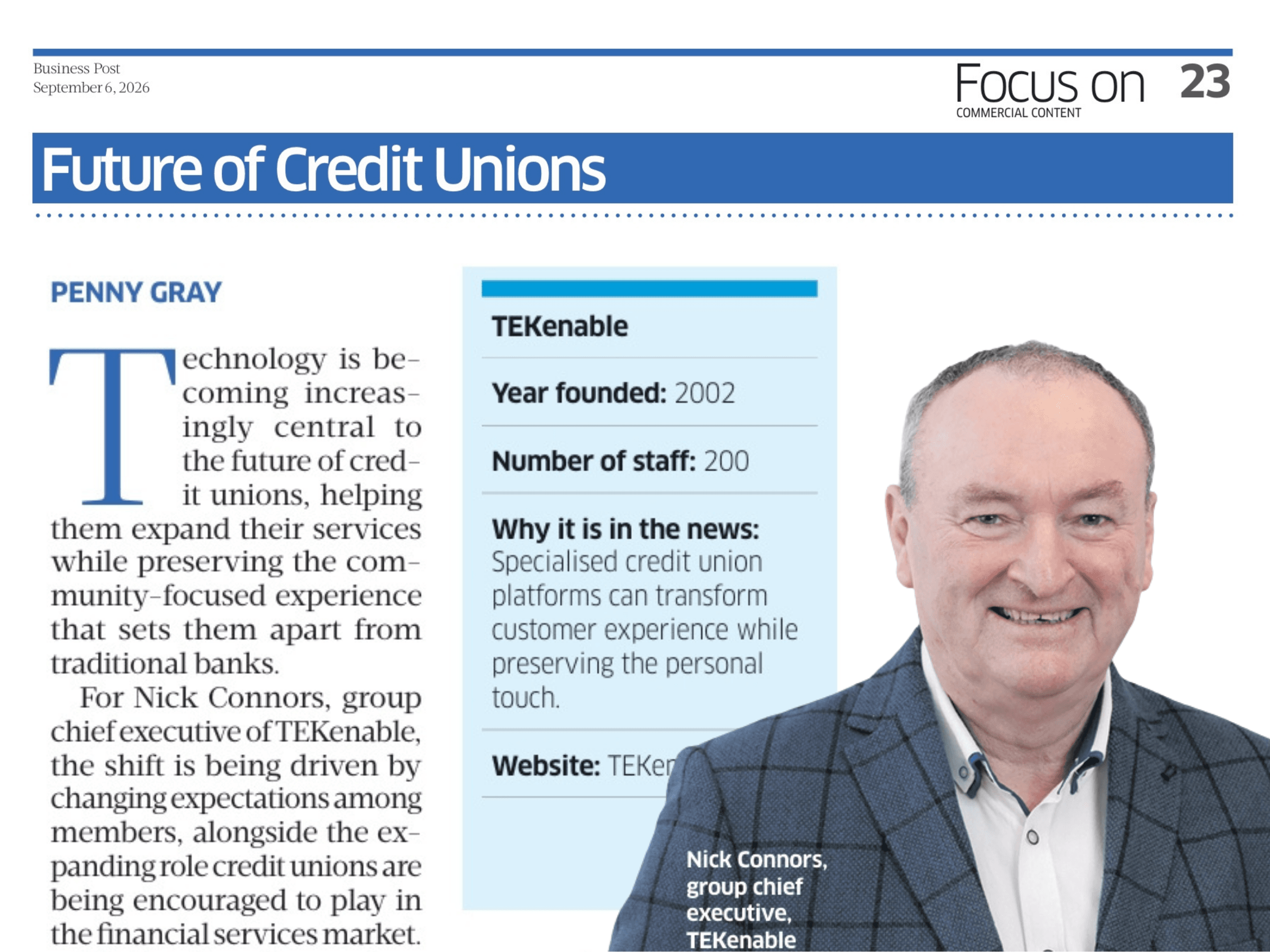
For Nick Connors, group chief executive of TEKenable, the shift is being driven by changing expectations among members, alongside the expanding role credit unions are being encouraged to play in the financial services market.
“Technology is now becoming front and centre for certainly the larger credit unions,” he said. “The expectation of their members would be similar to a banking experience that the larger pillar banks would have.”
That means giving credit unions the technology infrastructure to support a broader range of products and services, from mortgages and business lending to current accounts, while creating a more joined-up experience for members. TEKenable has been working with Member First Credit Union on what it calls an MX, or member experience, platform, designed to extend across the organisation rather than focusing on a single function.
“It’s a member experience platform that extends right throughout a credit union,” Connors explained. “A credit union is made up of many different areas, similar to a bank, and our platform sits across the whole credit union.”
The approach also addresses one of the long-standing challenges created by fragmented technology estates, where different systems can leave data spread across an organisation.
Connors argues that centralising data can make both day-to-day management and decision-making considerably easier. “The governance becomes much easier once you centralise your data,” he said. “In the past, a lot of credit unions would have bought off-the-shelf packages to do different things within the credit union, so your data set never really married up.”
AI is now adding another layer of opportunity. Connors points to applications ranging from digital agents capable of answering member queries outside opening hours to automating routine administrative work.
“One very easy one, and one that is obvious, is a digital agent that can answer the questions of members or potentially new members who might ring in on a Sunday when the credit union is closed,” he said.
AI could also automate a significant proportion of incoming data, emails and routine queries, allowing employees to spend more time on complex work. Connors estimates that around 80 per cent of some processes could potentially be automated.
“AI is becoming front and centre as support with staff, but also for the credit union themselves,” he said.
Many might worry that digitalisation might harm the unique personl and community-based approach of the credit union, but Connors argues that instead, technology can give members greater choice over how they interact.
“You have the best of both worlds,” he said. “You have the digital presence that will get you to a point that, if I need to talk to someone, you can actually talk to someone.”
That balance could become increasingly important as younger members expect digital convenience while still valuing personal advice for significant financial decisions.
TEKenable’s MX platform is designed to support that broader model, integrating with banking systems and bringing together front-, mid- and back-office functions.
For Connors, the opportunity is ultimately about giving credit unions the technology to grow without losing what makes them distinctive.
“They still have that personal touch and they know you, they know your family,” he said. “If traditional banking is moving away from that, credit unions are embracing it – and that’s where they’re getting an edge.”