Artificial intelligence (AI) may dominate boardroom conversations, but many organisations are discovering that AI is only as effective as the systems and data that underpin it.
For businesses eager to embrace AI, the reality is that many are still grappling with fragmented systems, disconnected data and manual processes that make it difficult to gain a clear view of their operations.
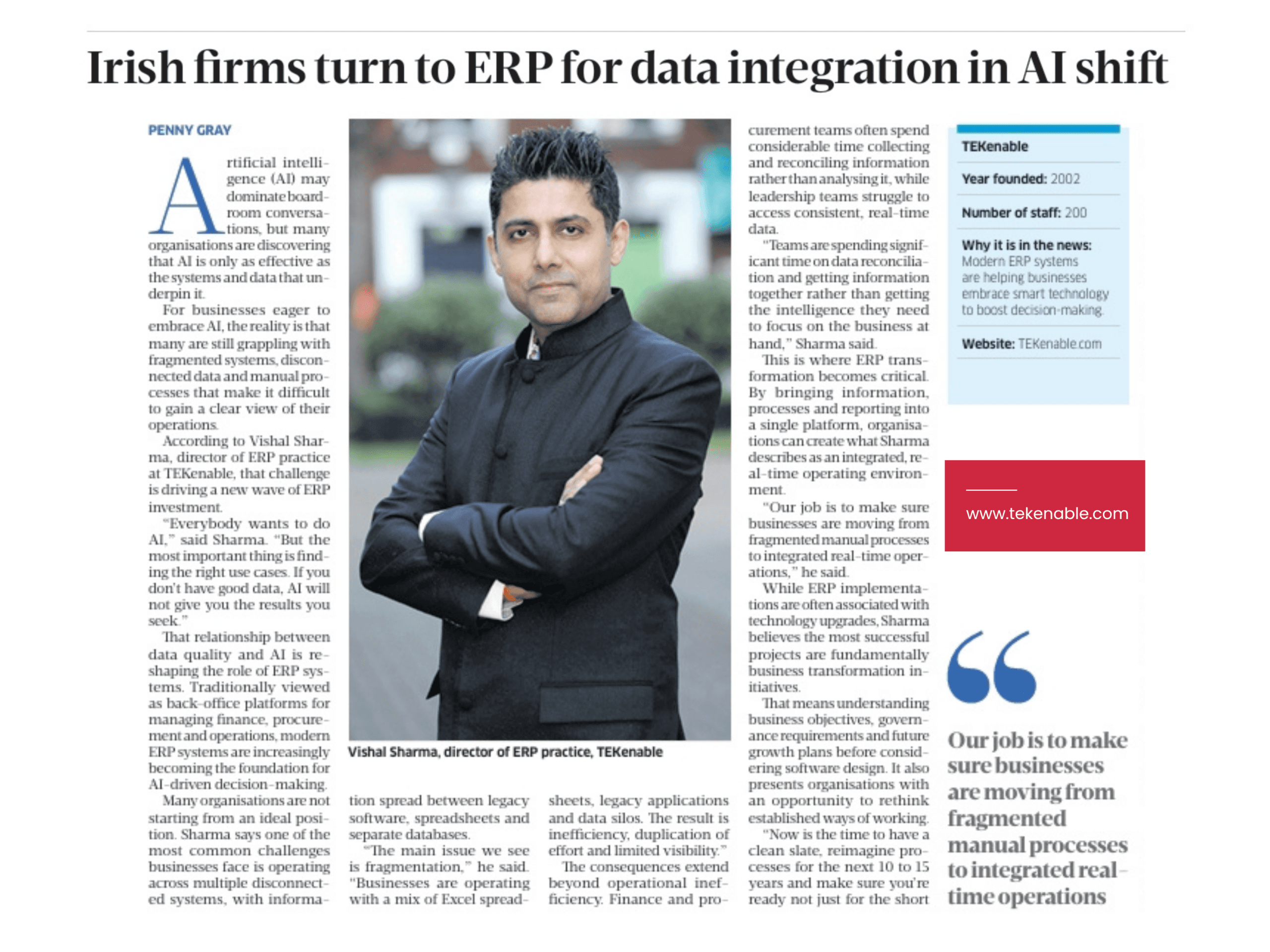
According to Vishal Sharma, director of ERP practice at TEKenable, that challenge is driving a new wave of ERP investment.
“Everybody wants to do AI,” said Sharma. “But the most important thing is finding the right use cases. If you don’t have good data, AI will not give you the results you seek.”
That relationship between data quality and AI is reshaping the role of ERP systems. Traditionally viewed as back-office platforms for managing finance, procurement and operations, modern ERP systems are increasingly becoming the foundation for AI-driven decision-making.
Many organisations are not starting from an ideal position. Sharma says one of the most common challenges businesses face is operating across multiple disconnected systems, with information spread between legacy software, spreadsheets and separate databases.
“The main issue we see is fragmentation,” he said. “Businesses are operating with a mix of Excel spreadsheets, legacy applications and data silos. The result is inefficiency, duplication of effort and limited visibility.”
The consequences extend beyond operational inefficiency. Finance and procurement teams often spend considerable time collecting and reconciling information rather than analysing it, while leadership teams struggle to access consistent, real-time data.
“Teams are spending significant time on data reconciliation and getting information together rather than getting the intelligence they need to focus on the business at hand,” Sharma said.
This is where ERP transformation becomes critical. By bringing information, processes and reporting into a single platform, organisations can create what Sharma describes as an integrated, real-time operating environment.
“Our job is to make sure businesses are moving from fragmented manual processes to integrated real-time operations,” he said.
While ERP implementations are often associated with technology upgrades, Sharma believes the most successful projects are fundamentally business transformation initiatives.
That means understanding business objectives, governance requirements and future growth plans before considering software design. It also presents organisations with an opportunity to rethink established ways of working.
“Now is the time to have a clean slate, reimagine processes for the next 10 to 15 years and make sure you’re ready not just for the short term but for medium and long-term growth as well,” Sharma said.
The benefits can be substantial. Sharma points to a recent multinational ERP transformation involving operations across Ireland, the UK, Europe and North America.
The organisation had been operating with fragmented legacy systems and heavily spreadsheet-driven processes, with little standardisation across the group.
Following the implementation of a unified ERP platform, the business reported a 30 to 35 per cent reduction in manual processing and efficiency improvements of approximately 25 per cent.
Month-end reporting cycles were also dramatically reduced, helping leadership teams gain faster access to critical business information.
These kinds of improvements are increasingly important as organisations seek to make greater use of AI capabilities.
Modern ERP platforms are embedding AI directly into everyday business processes.
Rather than searching through reports or relying on specialist knowledge, employees can increasingly interact with systems using natural language.
“People can ask simple questions such as ‘Who are my top customers?’ or ‘What is my total spend this month with this supplier?’ and get answers immediately,” Sharma said.AI is also helping automate labour-intensive administrative tasks.
Intelligent agents can process supplier invoices, extract information from documents, perform matching checks and support approvals with minimal human intervention.
Expense management can be streamlined through automated categorisation and policy validation, reducing workload while improving consistency and compliance.
“The outcome is efficiency, but it’s also about data accuracy, reporting and decision-making,” Sharma said.
As AI capabilities continue to evolve, the real challenge is ensuring the underlying data and business processes are robust enough to support it. For Sharma, that is why ERP remains a strategic investment rather than simply a technology project.
“The move to cloud is not a question of if, but when and how,” he said. “ERP is no longer just recording information and reporting on it. It is evolving from a system of record to a system of intelligence.”